Packaging for fresh greens is more than just protecting the product from external influences. It is a key element in preserving the freshness and quality of the greens, and it also plays an important role in marketing and sales. Modern consumers seek to purchase products that are not only fresh and high-quality but also eco-friendly, attractive, and convenient to use. In this article, we will focus on various aspects of packaging fresh greens – from the types and materials of packaging to the methods of its production. We will consider how to correctly choose packaging for different types of greens and also find out which technologies and equipment are used in this process. It is important not only to ensure the freshness of the product but also to present it to the consumer in the most advantageous light, which directly affects business success.
Types of Packaging for Greens:
- Roll packaging with micro or macro perforation: This type of packaging provides optimal air circulation inside the package, helping to avoid over-moisturizing the greens. Micro-perforation creates small holes of 1-1.5 mm, ideally suited for fine greens, while macro-perforation with larger holes is better for bulky bunches of 6-8 mm. It is mainly used in automatic lines which speeds up the packaging process and reduces the number of employees involved.
- Anti-fog effect: Packaging with an antifog effect prevents the formation of condensation inside the package, ensuring better visibility of the product. This is important for consumers who want to see the quality of the greens before purchasing.
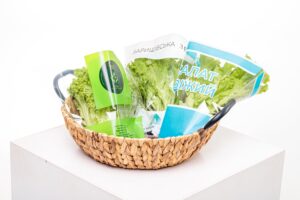
- Conical packages with and without perforation: Conical packages are suitable for large bunches of greens or if they are placed in pots, such as lettuce, or basil. Perforation adds extra ventilation, which is useful for preserving freshness.
- Rectangular packages with perforation: This type of packaging is ideally suited for standard volumes of greens, for example, for dill, parsley, onions, and green mixes. Perforation allows the greens to “breathe,” maintaining their freshness.
Types of Materials in Packaging:
 The main types of packaging used for packing greens are:
- BOPP (Biaxially-Oriented Polypropylene Film) 25-30 microns: This material is distinguished by high strength and clarity, it maintains a shape that protects the plant. It is ideally suited for packaging that must withstand transportation and look attractive to buyers.
- CPP (Cast Polypropylene Film) 30 microns: Noted for its high elasticity, it is less transparent and does not hold its shape as well as BOPP. This material is often used for packaging a large quantity of greens, as these packages behave more predictably when the package is detached from the valve.
Choosing Packets for Different Types of Greens and Their Standard Sizes:
- Dill and parsley: use straight packets that are ideally suited for these types of greens. They allow for conveniently placing bunches in retail equipment. Perforation in such packets helps maintain the freshness of the herbs.
- Standard sizes: width 130 – 150 mm, height 320-350 mm, film thickness 20-25 microns.
- Onion: use straight packets. They allow for conveniently placing bunches in retail equipment. Perforation in such packets helps maintain the freshness of the herbs.
- Standard sizes: width 100 – 130 mm, height 560 – 600 mm, film thickness 20-25 microns.
- Ready salad mixes: Roll packaging is most often used, allowing for packaging on automatic lines modifying the environment and keeping the salad fresh and presentable, especially when they are made from materials with an antifog effect.
- Standard sizes: width 400 – 450 mm, film thickness 30 microns.
- Potted salad: For such products, conical packets with or without perforation can be used, providing protection from the external environment during transportation.
- Standard sizes: top width 250-300 mm, height 350 -400 mm, bottom width 80-100 mm, film thickness 25-30 microns.
Designing packaging for herbs
Differences between Manual and Automatic Packaging
- Manual Packaging: This method is often used for small batches or specialized orders. Manual packaging allows greater flexibility in choosing sizes and shapes of packaging, as well as providing additional quality control. However, it is more labour-intensive and time-consuming.
- Automatic Packaging: Used for mass production. Automatic packaging machines can quickly process large volumes of products, standardizing the sizes and shapes of the packets. This increases productivity and reduces labour costs.
Standard Shelf Life of Greens Depending on the Chosen Packaging
- Perforated Packaging: This type of packaging preserves the product for up to 10 days. Perforation allows air to circulate inside the packet, helping to keep the greens fresh.
- Modified Atmosphere Packaging: Extends the shelf life of greens to up to 14 days. This type of packaging regulates the gas composition inside the packet, increasing the product’s shelf life.
Benefits of Different Types of Packaging
- Perforated Packaging: Helps to maintain the freshness of the greens, ensuring air exchange and preventing moisture accumulation.
- Antifog Packaging: Prevents condensation inside the packet, improving the visibility of the product and making it more attractive to buyers.
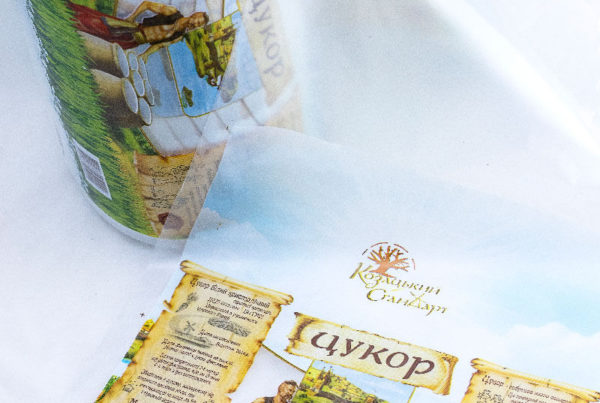
Modified Atmosphere Packaging: Maintains an optimal gas balance inside the packet, ensuring a longer shelf life for the greens.- Printed Packaging: Allows for branding and product information, increasing market attractiveness and aiding in marketing.
Each type of packaging has its own features and advantages, and the choice depends on the specific needs of the business and requirements for storage and presentation of the products.
Equipment Used in Production
- Bobbin Cutter: We use bobbin cutters from Taiwan (BJK-K1300) to create flexible roll packaging. This can be single-layer or multi-layer laminate (polymer material) used for forming packaging on vertical or horizontal packaging lines.
- MPL MOD-120 Corner and Packet 550, 680, 780 (China): These machines are used for producing packets by sealing the side seams and, in some cases, the bottom of the packet. They also provide cutting of the fabric into rolls with parameters required by customers, taking into account the width, diameter, and weight of the bobbin/roll.
- Perforating Machines No. 1 “1000”, No. 2 “600”, and No. 3 (Europerforation): These machines are used for perforating flexible packaging, which includes puncturing the fabric with a hot needle (hot perforation) or various cutting tools (cold perforation) to create ventilation inside the packaging.
- Flexotechnika Tachys FDR 850/6 (Taiwan) and FPHS-6HS: These printing machines are used for applying print to the film.
What to Know for Ordering Packaging
When ordering packaging, consider the following aspects:
- Type of Packet: Determine the type of packet you need (conical, rectangular, perforated, etc.).
- Size and Shape: Specify the required sizes and shapes of the packet according to your products.
- Quantity: The order volume significantly affects the cost per unit.
- Material: Choose the appropriate packaging material, considering factors such as strength, transparency, and barrier properties.
- Additional Requirements: Specify any special requirements, such as perforation, lamination, printing, etc.
Standard Production Terms
Standard production terms depend on the volume of the order, type of packaging, and production capabilities. Typically, the process can take from several days to several weeks. Exact production timelines will be established after all order details are agreed upon.
In conclusion, effective packaging of fresh greens is critically important for ensuring their freshness, attractiveness, and preservation. Understanding the different types of packaging, materials, and their properties allows for the selection of the optimal option that will meet the specific needs of your product. Using modern equipment and technologies in the packet production process not only increases efficiency but also ensures the high quality of the final product.
Considering the standard shelf life of greens, it is important to choose packaging that will extend the product’s storage life while also maintaining its aesthetic appearance. Properly chosen packaging not only contributes to the preservation of the quality of the greens but also enhances their marketing appeal, which is key for successful sales in the modern retail and agribusiness environment.
Finally, ordering and producing packaging for fresh greens requires a careful approach and an understanding of market needs. It’s not just about protecting the product but also about creating added value for your brand identity and meeting consumer expectations. Successful use of the right packaging can significantly impact the success of your business in the agricultural sector.