Packaging for Export to the EU: Supplier Requirements
Exporting products to the EU? Check your packaging for compliance with Regulation (EU) 2025/40 (PPWR): GMP, migration safety, DoC, traceability, recyclability, and a supplier checklist.
Entering the European market often starts with the product: formulation, quality, batch consistency, documents, logistics. But there is another factor that can easily be underestimated — packaging. For the EU, this is not just film, a bag, or attractive printing. Packaging, especially when it comes into contact with food products, must be safe, traceable, technologically stable, and supported by documentation.
If a manufacturer of food, agricultural, or related products plans to export to the EU, the packaging supplier becomes part of the safety chain. It is evaluated not only by price, lead times, and appearance. GMP, migration testing, Declaration of Compliance, raw material control, batch traceability, printing consistency, absence of foreign odors, and packaging recyclability become important.
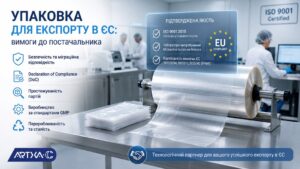
In other words, the question is no longer: “Where can I order film more cheaply?” The right question is different: “Will this supplier be able to pass an audit as part of our export supply chain?”
That is why, when choosing packaging for export, it is worth evaluating more than just the price. It is important to look at the supplier more broadly: whether it has a quality management system, whether it can confirm material safety, whether it works with laboratory testing, whether it understands food-contact requirements, and whether it can consistently reproduce parameters from batch to batch. In this context, Artha-S acts not simply as a manufacturer of polymer packaging, but as a technological partner for B2B companies that need packaging with confirmed quality.
How Packaging Requirements Have Changed in the EU and Ukrainian Markets
Previously, packaging was often evaluated according to three simple criteria: price, appearance, and production time. Today, this is not enough. For the European market, packaging must meet two major groups of expectations:
- Food Safety — safety of materials that come into contact with food products.
- Sustainability — environmental friendliness, waste reduction, recyclability, and the logic of the circular economy.
For product manufacturers, this means that if packaging does not have confirmed compliance, problems may arise not at the sales stage, but during an audit, negotiations with a retail chain, or approval by a European partner.
Key documents used as reference points in the field of food-contact materials:
- Regulation (EC) No 1935/2004 — general safety principles for materials and articles intended to come into contact with food.
- Regulation (EC) No 2023/2006 — good manufacturing practice, or GMP.
- Regulation (EU) No 10/2011 — requirements for plastic materials, including migration limits and declaration of compliance.
- PPWR / Regulation (EU) 2025/40 — new EU requirements for packaging and packaging waste, including recyclability, reduction of excessive packaging, and more transparent waste management.
For Ukrainian businesses working with the EU, this is not distant bureaucracy. This is the language spoken by European procurement managers, auditors, retail chains, and manufacturing partners.
Why a Packaging Supplier Should Operate According to GMP Principles
GMP is not just about having a clean production facility. It is a system that must prove that packaging is manufactured in a controlled, consistent manner and without risks to the product. For polymer packaging, GMP includes several critical areas.
Production Zoning and Hygiene
Production facilities should have clearly separated areas: production zone, raw material warehouse, finished goods warehouse, staff facilities, material receiving area, and dispatch area.
For packaging that may come into contact with food products, it is important to reduce the risks of dust, insects, foreign objects, and microbiological contamination. A strong supplier has not only an orderly production facility but also established rules: cleaning, pest control, personnel training, protective clothing, and regulated access to production areas.
For the customer, this means one simple thing: if the supplier does not control the production environment, it does not control the risks to your product.
Batch Traceability
Traceability is one of the most important criteria for export. The supplier should understand which raw materials were used to manufacture a specific batch of film, rolls, or bags, which equipment was used, and which parameters were controlled.
In a good system, the following path should be clear: raw material → film → printing → slitting → perforation → bag/roll → customer batch.
In practice, this may be confirmed by a batch number, batch certificate, quality control log, material specification, information on thickness, width, winding, printing, perforation, and shipment.
If there is a complaint, traceability makes it possible not to look for someone to blame, but to quickly identify the cause: material, machine, shift, ink, sealing mode, raw material batch, or parameter error.
imagePrevention of Cross-Contamination
For food packaging, it is important that the manufacturer prevents the mixing of incompatible materials, foreign substances, or contamination through equipment. Risk areas may include process lubricants, ink residues, solvents, dust, foreign particles, residues from previous orders, improper storage of film, or finished bags.
That is why cleaning procedures, equipment maintenance, material control, and procedures for starting a new batch are important for the supplier.
Chemical and Migration Safety: What the Supplier Should Confirm
If packaging comes into contact with food, it must not transfer substances to the product in quantities that could be dangerous or change the composition, smell, taste, or appearance of the product.
- OML / Overall Migration Limit — overall migration of substances from the material.
- SML / Specific Migration Limit — specific migration of individual substances.
Simply put, laboratory tests should show that the material behaves safely under conditions corresponding to actual use. One scenario will apply to dry grocery products, another to fatty products, another to warm filling, and another to prolonged contact.
Why Virgin and Controlled Raw Materials Matter
For direct food contact, it is especially important to control the origin of polymers, additives, inks, and auxiliary materials. If a supplier uses unknown material or cannot confirm its origin, this creates a risk for the entire product batch.
That is why customers should ask which raw materials the supplier works with, whether specifications from material manufacturers are available, whether film documentation can be provided, whether a Declaration of Compliance can be obtained, and whether migration testing has been carried out.
Safe Printing and Odor Control
For printed packaging, risks are associated not only with the film but also with inks, solvents, and residual substances after printing. If the technology is selected incorrectly, the packaging may have a foreign odor or affect the organoleptic properties of the product.
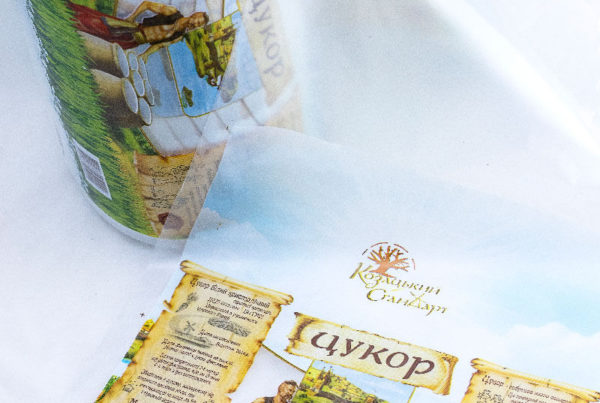
In flexible packaging production, flexographic printing is often used precisely because it is suitable for roll materials, allows work with different types of film, and enables high-quality designs to be applied to flexible packaging. But for food products, it is important not just to print a logo, but to ensure control of the surface, inks, drying, and consistency throughout the production run.
Declaration of Compliance: A Document Often Requested by European Partners
Declaration of Compliance, or DoC, is a declaration confirming that the material complies with the requirements applicable to a specific type of packaging. For plastic materials that come into contact with food products, such a document is particularly important.
A DoC is generally expected to include:
- identification of the manufacturer or supplier;
- description of the material or article;
- confirmation of compliance with applicable regulations;
- information on restrictions on use;
- conditions of contact with the product;
- results of or references to migration testing;
- information on substances subject to restrictions;
- date of issue of the document.
For procurement managers, this is an important filter. If a supplier does not understand what a DoC is or cannot explain which documents accompany a batch, this is a risk signal for the export supply chain.
What Artha-S Already Confirms: Certification, Laboratory Testing, and Documents
For companies preparing for export or undergoing supplier verification, it is important to see not only production capabilities but also documentary confirmation. That is why Artha-S focuses not only on manufacturing film, bags, and roll packaging, but also on production consistency, quality control, and laboratory testing of materials.
Artha-S holds a DSTU ISO 9001:2015 quality management system certificate. It covers the production and sale of plastic packaging, as well as printing of other products. The certificate is valid from 23.12.2025 to 23.12.2028. For a B2B customer, this means that quality within the company is treated not as a one-time inspection of a finished roll, but as a managed process with documentation, responsibility, control, and consistency in order fulfillment.
A separate argument for food packaging is laboratory testing of materials. Artha-S CPP film with flexographic printing was tested by Intertek Italia S.p.A. for parameters important to packaging safety: overall migration, specific migration of heavy metals, primary aromatic amines, odor, phthalate plasticizers, overall migration using Tenax simulant, and other parameters. In the key tests, the sample received the assessment “P — meets requirement,” meaning that it complies with the established requirements within the scope of the tests performed.
For BOPP film, Artha-S has LABEKO test reports. LABEKO is an accredited testing laboratory in accordance with STN EN ISO/IEC 17025. It is important that this is not an internal manufacturer assessment, but independent laboratory testing. BOPP film samples were evaluated with consideration of European requirements for materials intended to come into contact with food, including Regulation 1935/2004/EC, Commission Regulation (EU) No. 10/2011, and Commission Regulation (EU) No. 2020/1245.
According to the test results, the tested BOPP film samples comply with the requirements of the specified European regulations within the scope of the migration tests performed and do not cause unacceptable changes in the organoleptic properties of food products. For an exporter, this has practical value: when a partner or retail chain requests confirmation of packaging quality, it is important to provide not general promises but specific documents.
An important clarification: compliance of specific packaging always depends on the material, product, contact conditions, temperature, storage period, and buyer requirements. Therefore, for each export project, the technical specification, documents, and required level of laboratory confirmation should be agreed separately.
Why Energy Efficiency and Production Stability Are Also Important
A European partner evaluates not only the material but also the reliability of the supply chain. If the packaging manufacturer cannot guarantee stable lead times, the entire product batch may be affected.
For Ukraine, this is particularly relevant. Customers should ask suppliers how production stability is ensured, whether backup scenarios exist in the event of power supply disruptions, how production lead times are planned, whether critical raw materials are kept in stock, how production priorities are set, and whether the supplier can maintain regular batch deliveries.
Artha-S Technological Capabilities for B2B Manufacturers
Artha-S works with polymer flexible packaging and can be useful for companies looking not simply for material, but for a technical solution tailored to the product.
Materials
The company works with BOPP, CPP, PE.
BOPP is a transparent, glossy, rigid material with barrier properties. Transparent, white, pearlized, metallized, and matte options are available. Typical thickness ranges from 15 to 40 microns.
CPP is an elastic material with high transparency, mechanical strength, heat-sealing capability, and the possibility of applying microperforation. Thickness ranges from 25 to 40 microns.
PE includes polyethylene materials used where strength, water and vapor impermeability, impact resistance, and reliable welded joints are required. The working production range depends on the task and is often from 25 to 100 microns.
Production Processes
- flexographic printing;

- film slitting;
- microperforation;
- macroperforation;
- folding into half-sleeve format;
- bag production;
- production of flexible roll packaging;
- production of flat bags;
- production of cone-shaped bags;
Technical Parameters
| ProcessParameters | |
|---|---|
| Slitting | maximum material width up to 1200 mm; material thickness — 15–100 microns; |
| Hot perforation (microperforation) | material width up to 1100 mm; material thickness — 20–60 microns; hole diameter — 1 mm; maximum number of lanes — 4. |
| Cold perforation (macroperforation) | material width — 230–500 mm; material thickness — 20–80 microns; hole diameter — 4–5 mm. |
| Printing | up to 8 colors; material width up to 1200 mm. |
Minimum Order Quantities
- transparent film — from 20 kg;
- transparent film with perforation — from 50 kg;
- transparent film with macroperforation — from 50 kg;
- printed film — from 100 kg;
- transparent flat bags — from 20 kg;
- printed flat bags — from 100/200 kg depending on the number of colors;
- transparent cone-shaped bags — from 20 kg;
- printed cone-shaped bags — from 100/200 kg depending on the number of colors.
Auditor’s Checklist: How to Check a Packaging Supplier in 10 Minutes
Below is a quick table for a quality director, technical director, or procurement manager.
| CriterionWhat to Ask the SupplierWhy It Matters | ||
|---|---|---|
| Certification and quality system | Are ISO certificates, GMP procedures, and internal control regulations available? | Shows production maturity and audit readiness. |
| Declaration of Compliance | Can the supplier provide a DoC and material documentation? | Required for food contact and European partners. |
| Migration testing | Are OML/SML test reports available, or can they be arranged? | Confirms the chemical safety of the material. |
| Laboratory confirmation of materials | Are BOPP/CPP film test reports, migration test results, odor tests, and safety parameter checks available? | Increases confidence in packaging during export, buyer audits, and food-contact verification. |
| Inks and odor | What inks are used, and is foreign odor controlled? | Important for the organoleptic properties of food products. |
| Batch traceability | Is there a lot number, batch certificate, and control log? | Makes it possible to quickly identify the cause of a problem. |
| Supply stability | How are lead times, energy resilience, and the production plan ensured? | Reduces the risk of disruption to an export contract. |
| Technical capabilities | What widths, thicknesses, printing, perforation, and bag options are available? | Shows whether your specific technical specification can actually be fulfilled. |
| Test samples | Can samples be provided for laboratory testing and machine trials? | Makes it possible to test the packaging before the main production run. |
If the supplier responds with specific parameters, documents, and examples, this is a strong signal. If the answers are general, without figures or documentation, the risks should be assessed more carefully.
Why Are Migration Tests Needed?
Migration testing shows whether substances migrate from packaging into the product in quantities that may be dangerous or affect the smell, taste, or composition of the product.
Can BOPP Be Used for Food Packaging?
Yes, BOPP is widely used for flexible food packaging. However, it is important to correctly select the film type, thickness, heat-sealing layer, activation layer for printing, and documentation for the specific application.
When Is Perforation Needed?
Perforation is needed when a product releases moisture or requires air exchange. For example, for bread, greens, vegetables, or products where condensation may worsen the product’s commercial appearance.
Can Artha-S Manufacture Printed Packaging?
Yes. Artha-S provides flexographic printing on flexible materials in up to 8 colors and works with roll packaging, film, and bags.
What Documents Can Artha-S Show as Evidence of Reliability?
On its certification page, the company lists DSTU ISO 9001:2015, laboratory testing of CPP film by Intertek Italia, LABEKO reports for BOPP film, and membership in the Dnipropetrovsk Chamber of Commerce and Industry.
Conclusion
Exporting to the EU is not only about having a high-quality product. It is about the entire system around it: packaging, documentation, safety, traceability, production stability, and audit readiness.
A packaging supplier should not simply be a film manufacturer, but a technological partner that understands materials, printing, perforation, food contact, batch management, and the requirements of the European market.
Artha-S can be a useful partner for businesses that need flexible polymer packaging: BOPP, CPP, PE, roll packaging, flexographic printing in up to 8 colors, perforation, slitting, and bags tailored to a specific product. Additional confidence is provided by DSTU ISO 9001:2015, laboratory testing of CPP film, LABEKO reports for BOPP film, and official membership in the Chamber of Commerce and Industry.
Planning to export to the EU or preparing for a buyer audit? Contact Artha-S. The team will help you select BOPP, CPP, or PE film, determine the packaging format, printing, perforation, and technical parameters, and prepare a solution that will be clear to procurement managers, technologists, and international partners.