Packaging for Greens: How to Preserve Freshness and Product Appeal
Fresh greens are products that “live” inside their packaging. Packaging either preserves their beauty and aroma or turns them into a soggy, unattractive mass. That’s why packaging for greens must be not only visually appealing but also functional — breathable, durable, and properly matched to the product type.
Artha-S offers packaging solutions that maintain freshness — and sell at first sight.
Why Packaging for Greens Matters
Parsley, dill, lettuce, mint, basil, and microgreens — all of these are highly perishable crops. Without proper packaging, greens quickly wilt, mould, and lose their presentation. Their preservation requires a careful balance of density, ventilation, and sealing.
That’s why packaging is not just a wrapper — it’s a key part of logistics, marketing, and customer care.
Problems Solved by Proper Packaging
-
Fogging and condensation inside the bag — the main reasons for spoilage.
-
Mould and decay due to excess moisture.
-
Loss of visual appeal, especially in supermarket refrigerators.
-
Damage during transportation occurs when the film is not strong enough.
Proper packaging protects the product, extends its shelf life, and makes it attractive on the shelf.
Which Film to Choose for Greens
BOPP — Clear and Glossy
-

Thickness: 15–40 microns
-
Has a heat-sealable layer on both sides (coextruded copolymer)
-
Ideal for retail packaging in supermarkets
-
Suitable for printing up to 8 colours, microperforation, and lamination
-
Provides gloss, transparency, and high barrier properties
CPP — Flexible and Heat-Resistant
-
Thickness: 15–40 microns
-
High transparency and resistance to fats and acids
-
Suitable for hot packaging and microperforation
-
Used when deformation resistance is required
PE (LDPE, HDPE) — For Durable Solutions
-
Thickness: 25–100 microns
-
Resistant to tearing and moisture
-
Used for large-volume packaging or technical applications
How to Extend Shelf Life: Perforation
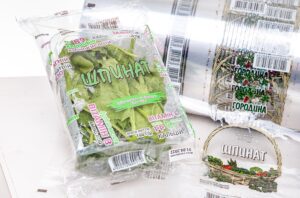
Proper ventilation is the key to longer freshness. Artha-S offers two perforation options:
-
Microperforation — holes approximately 1 mm in diameter, evenly distributed over the bag.
-
Performed by hot perforation
-
Maximum web width — 1000 mm, film thickness — 20–55 microns
-
Ensures constant air exchange and “breathing” of the product
-
-
Technical holes — 4–5 mm in diameter, usually at the bottom or sides.
-
Made by cold euro-perforation
-
Reduce fogging and allow steam and moisture to escape
-
Packaging with perforation allows greens to stay fresh 1.5–2 times longer without preservatives.
Packaging Formats for Greens
Flat Bags
-
Ideal for packaging portions of 50–150 g
-
Available options: flap, bottom gusset, euro slot, microperforation
-
Printing — up to 8 colours
-
Minimum order: from 20 kg without printing or from 100 kg with printing
Cone Bags
-
Suitable for greens in pots or bouquet-style packaging
-
Can have a sealed bottom (8–15 cm) for stability
-
Logo printing — up to 6 colours
-
Minimum order: from 20 kg without printing or from 100 kg with printing
Additional Packaging Features
-
Flap — for convenient sealing or attaching bags
-
Euro slot — for hanging on display racks
-
Reinforced seam — for higher tear resistance
-
Bottom gusset — increases volume and stability
Advantages of Working with Artha-S
-
Films in stock — no long waiting times
-
Custom orders from 20 kg, with printing — from 100 kg
-
Modern equipment: printing (up to 8 colours), slitting, perforation
-
Professional consultations from technologists
-
Turnkey production — film, printing, bag making, and delivery
Conclusion: Packaging Is Your Sales Partner
Packaging for greens is not just protection — it’s part of a successful product. It preserves the appearance, aroma, and freshness, extends shelf life, and sells at first glance.
Contact Artha-S to get expert consultation, samples, custom calculations, and consistently high quality.