Why dill, parsley, and salads quickly lose their “shelf appeal”
Greens are bought with the eyes — and they spoil just as visibly. The reason is simple: after cutting, dill, parsley, and salads keep breathing and actively releasing moisture. Then comes the real supply chain: warehouse → truck → fridge → shelf display. Temperature swings almost inevitably trigger condensation.
What happens in a “sealed” pack without ventilation? Moisture has nowhere to go, so it settles as droplets on the film, the leaves get wet — and you get the classic set of problems: darkening, slime, unpleasant odor, mold. The opposite scenario is when the pack “breathes too much”: greens dry out quickly, lose firmness, and look tired by the next day.
That’s why packaging for greens is not just “something to have,” but a tool that directly affects condensation, shrink, and customer trust on the shelf.
What greens packaging needs: 3 requirements
To keep greens looking marketable, packaging must solve three tasks:
1) Transparency and shelf presentation
The customer must be able to see the product: freshness, color, leaf structure. This is especially important for salad mixes and packed greens under private label.
2) Protection from contamination and mechanical damage
In logistics, bunches and containers rub against cartons, packaging gets crushed, and leaves break. The film must hold its shape and not “split” at the seams.
3) Ventilation / moisture removal — the key factor
Ventilation most often “decides the fate” of the product: either you control the microclimate, or condensation controls you.
Which film to choose for greens (BOPP vs CPP vs PE)
BOPP film — when shelf impact and a “fresh look” matter
BOPP film for greens packaging is popular due to high transparency, gloss, and a neat retail presentation. It is strong, has good barrier properties, and looks “clean” in retail. Depending on design and positioning, different BOPP options can be used: clear/white/pearlized/metallized/matte.
Important production nuances:
-
Heat-seal layer — needed if the film must be sealed (on a line or by sealing jaws).
-
Corona treatment — needed if you plan printing (for stable ink adhesion).
CPP — when you need flexibility and reliable sealing
CPP is a more elastic film that handles line operating conditions well and provides reliable sealing. It fits when you need a balance of “strength + sealing,” and when you want to flexibly adjust ventilation — including via microperforation.
PE (LDPE/HDPE) — when you need toughness and “heavy-duty” logistics
Polyethylene solutions are chosen when the key needs are strength, water/vapor resistance, bulky packs, or challenging logistics. But keep in mind: PE without ventilation easily creates a “greenhouse,” so perforation/holes are often critical.
Short practical tip: for supermarket shelves, BOPP often wins on visual impact, while the “freshness secret” is not the magic of the material — it’s properly selected ventilation.
 Ventilation in packaging — the main “freshness secret”
To avoid the “wet film — dark greens” situation, you need controlled airflow. There are different methods, and it’s important not to mix them up.
Microperforation (hot)
Microperforated film has small holes made with a heated needle. A typical hole diameter is 1 mm. This ventilation is gentle: moisture escapes gradually, and greens don’t dry out “to zero.” It’s one of the best options when your goal is greens packaging without condensation (or with minimal condensation) while keeping leaf firmness.
Euro-perforation (cold / macro)
Macroperforation / Euro-perforation means 4–5 mm holes and more intensive airflow. It’s appropriate when moisture is high or when logistics and temperatures “swing,” and you need faster vapor removal.
Technical holes in bags
Bags with technical holes are “boosted ventilation”: an 8 mm hole for air/moisture release. A flat bag can have up to 8 holes.
When to choose what (plain language)
-
If you constantly see condensation and “wet film” → increase ventilation: micro 1 mm → Euro 4–5 mm → 8 mm technical holes (depending on the format).
-
If greens dry out and become “fluffy/wilted” with no droplets → reduce ventilation (or switch to a more delicate perforation mode).
Greens packaging formats
Roll stock film for packing lines (VFFS/HFFS)
For vertical/horizontal packing lines, roll stock film is most common: it’s easy to adapt to speed, required width, printing, and perforation. This is the standard route for stable volumes and private label.
Flat (portion) bags
If packing is manual or semi-automatic, flat bags are used. Options can be added for logistics and display:
-
8 mm technical holes (up to 8 pcs.) — for active moisture removal;
-
bottom gusset — for bulkier packs and better stability;
-
flap / euro-slot — when required by a retail chain or display format.
Printing on greens packaging: how to increase recognition and sales
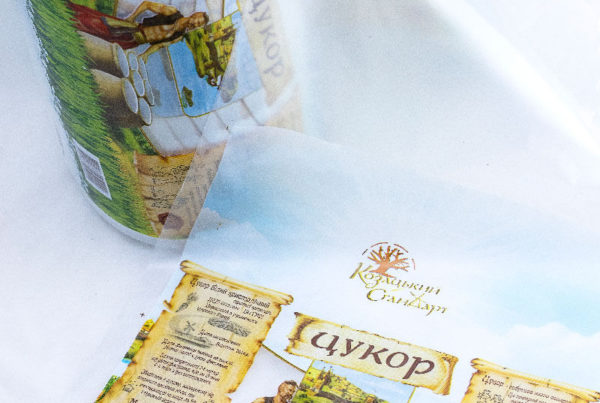
In retail chains, greens often compete not by taste but by trust: “good look + clear label.” Flexographic printing turns packaging into part of the brand: logo, weight, variety, “washed/unwashed” marks, storage tips, QR codes to social media or recipes.
ARTHA-S offers flexo printing up to 8 colors — enough to create a consistent line style and stand out on the shelf.
ARTHA-S technical capabilities
-
Hot perforation: material width 250–1000 mm, thickness 20–55 μm, hole 1 mm.
-
Euro-perforation: width 230–500 mm, thickness 20–80 μm, hole 4–5 mm.
-
Printing: up to 8 colors, width 300–1200 mm.
-
Slitting: 120–1200 mm, thickness 15–100 μm.
This means you can build a complete solution for one product: material + perforation + printing + format (roll or bags).
Commercial terms
-
Clear film — minimum order from 20 kg.
-
Clear film with perforation — minimum order from 50 kg.
-
Clear film with Euro-perforation — minimum order from 50 kg.
-
Printed film (up to 6 colors / more than 6) — minimum order from 300 kg.
-
Clear flat bags — minimum order from 20 kg; printed flat bags — from 200/300 kg (depending on the number of colors).
Conclusion
Dill, parsley, and salads are a delicate category: either you manage moisture, or it manages your shrink. The right film + ventilation (micro/Euro-perforation or technical holes) gives what matters for B2B: stable shelf look, fewer claims, and stronger customer trust.