Import or a Ukrainian manufacturer — what really matters for packaging
Packaging isn’t just “film around a product.” It’s part of your sales and logistics process: how the product looks on the shelf, how shelf life holds up, whether seals fail on your line, whether film perforation is consistent. That’s why “price per kilogram” is only one criterion. In real business, you also weigh:
-
risks (customs, FX rate, delays, damage in transit);
-
flexibility (quickly change width, perforation, artwork, bag format);
-
response time (when season/promo is “already yesterday”);
-
repeatable quality (seals, print, thickness, roll consistency).
This is where packaging directly from the manufacturer often wins — especially when it’s a flexible packaging manufacturer in Ukraine with full-cycle production.
The strengths of import (briefly and honestly)
Imports do have advantages:
-
a wide range of “typical” solutions from large suppliers;
-
sometimes an attractive price at very high volumes;
-
access to niche materials in certain segments.
But most import advantages depend on one thing: stable logistics and predictability. And that’s where the nuance starts — customs, exchange rate, queues, delays, and complex claims.
Where import loses in real business (risks that “cost money”)
1) Unpredictable delays.
If packaging is “in transit” while you’re in the herb/flower season or running a retail promo, you lose not days but sales. A few days of line downtime often costs more than the “savings” on purchase price.
2) Claims and repeat shipments.
If something is off with thickness, printing, or sealing, it’s faster to resolve locally. With imports, it’s usually slower, more expensive, and too often becomes “emails instead of a solution.”
3) High cost of changes.
Need to adjust roll width for your VFFS/HFFS machine, switch perforation type, or update artwork for a new SKU? With imports that often means new lead times, new MOQs, and additional logistics costs.
4) Stock on hand = frozen cash.
To hedge delivery risk, businesses keep larger packaging inventories. That’s money that could be working in raw materials or marketing.
A Ukrainian manufacturer = speed, control, adaptation
A local manufacturer isn’t about patriotism in procurement. It’s about control and speed:
-
seasonality (herbs, flowers, holidays) when artwork/volumes change in a week;
-
promo batches for retail chains that require quick response;
-
tuning roll/bag parameters to your line (seals, tension, slitting, format);
-
the ability to repeat or correct a batch quickly without waiting on international logistics windows.
If repeatability and predictability matter, a Ukrainian packaging manufacturer usually brings fewer “field surprises.”
What Artha-S does: production cycle and services
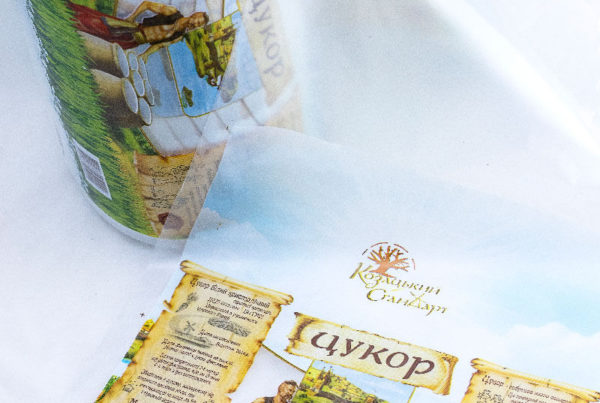
Artha-S is a full-cycle producer: film → slitting → perforation → printing → bags. That means you work with one partner accountable for the end result, not a chain of “broker—carrier—printer—bag maker.”
Materials
-
BOPP: clear/white/pearlized/metallized/matte; typical thickness 15–40 μm.
-
CPP: 15–40 μm; suitable for different print types; supports microperforation.
-
PE: working range 25–100 μm (when strength/durability is needed).
This is where a query like “BOPP CPP PE film manufacturer” becomes real material selection for your product and line.
 Printing
-
Flexographic printing up to 8 colors, roll-to-roll — ideal for brands, private label, seasonal designs.
Perforation
-
Hot microperforation: 1 mm hole — controlled ventilation (relevant for fresh herbs and certain fresh products).
-
Euro-perforation (cold): 4–5 mm hole — when stronger air exchange is needed.
Roll slitting
Slitting to customer parameters (width/weight/roll geometry) is critical for stable VFFS/HFFS performance so you don’t “fight the tension” and lose speed.
Bag manufacturing
-
Straight (packing) bags + options: bottom gusset, 8 mm technical holes, reinforced seal, euro slot, flap, etc.
-
Conical/trapezoid bags (for flowers and salads) + bottom seal 8/10/15 cm + 8 mm technical holes (up to 4 pcs) — a solution that improves display and reduces “wet surprises” in logistics.
If you’re sourcing bags for herbs / flowers / bread in bulk, this matters because it’s not “one SKU,” but a system tailored to your workflow.
Comparison table: Ukrainian manufacturer vs import
| Criterion | Ukrainian manufacturer (Artha-S) | Import |
|---|---|---|
| Response time for changes | Fast: width/perforation/format tweaks | Often slow: approvals + logistics |
| Supply risks | Lower (no customs/international delays) | Higher (customs, queues, transit damage) |
| “Price with risks” | More transparent (fewer hidden costs) | Can rise with FX/logistics/downtime |
| Customization | Flexible: line fit, season, promo | Expensive/slow, often higher MOQs |
| Claims handling | Faster and simpler | Slower; returns/replacements harder |
| Perforation options | 1 mm (hot) + 4–5 mm (euro) | Available, but changes are slower |
| Printing | Flexo up to 8 colors | Depends on supplier chain |
| Seasonal peaks | Easier to support demand spikes | Requires larger advance stock |
| Minimum order quantities | Start with smaller MOQs | Often larger MOQs for best price |
Cooperation economics: minimum batches and flexible ordering (with numbers)
One of the strongest reasons to go local is not freezing your budget in inventory.
Artha-S minimums allow testing, seasonal launches, and artwork updates without buying “half a year ahead”:
-
Clear film — from 20 kg.
-
Clear perforated film — from 50 kg.
-
Clear film with euro-perforation — from 50 kg.
-
Printed film (up to / over 6 colors) — from 200 kg.
-
Clear straight bags — from 20 kg; printed — from 200/300 kg.
-
Clear conical bags — from 20 kg; printed — from 200/300 kg.
This is especially valuable in seasonal categories: herbs, flowers, holiday ranges, promo packaging.
How to switch from import to a local manufacturer without pain (step-by-step)
-
Send your current sample or specs (material, thickness, width, bag/roll type, photos of seals/print).
-
Confirm material (BOPP/CPP/PE), thickness, and whether you need a sealing layer for welding and corona treatment for printing.
-
Confirm perforation/slitting/bag format: 1 mm / 4–5 mm / 8 mm technical holes, bottom gusset, flap, etc.
-
Test batch at the minimum volume — validate on your line and in logistics.
-
Serial deliveries + a seasonal plan schedule (so you don’t live in “urgent yesterday” mode).
This turns the changeover into a controlled project with checkpoints.
Conclusion
Import can be fine — especially for standard solutions and large volumes. But when lead time, repeatability, fast changes, and lower logistics risk matter, a local partner often wins in practice.