Packaging for Fresh Herbs and Greens: How to Preserve Freshness and Aroma
Fresh greens are among the most delicate products in retail: they wilt quickly, darken, lose their firmness, and fade in aroma. Even if the greens are grown perfectly, the wrong packaging can ruin the result within hours. Proper packaging for greens functions like a microclimate, controlling humidity, facilitating air exchange, protecting against contamination and mechanical damage, and presenting the product attractively on the shelf.
Storage specifics for fresh greens
After cutting, greens don’t “stop” — they continue to actively respire, release moisture, and gradually lose turgor (the firmness of leaves and stems). Add sensitivity to temperature fluctuations, and you get the main packaging challenge: condensation forms easily inside the bag.
That’s why a standard “sealed” polyethene bag without ventilation is often a poor solution for fresh greens. Moisture can’t escape, a “greenhouse effect” appears, the product starts to sweat, darken, and develop a characteristic, unpleasant smell. The bag seems to protect the greens — but in reality, it speeds up spoilage.
In contrast, the right material and perforation help:
-
reduce condensation build-up,
-
maintain bright colour and shelf appeal,
-
extend selling time/shelf life,
-
preserve the natural aroma (without a “swampy” off-note).
Materials for packaging greens
BOPP film (biaxially oriented polypropylene)
BOPP is a more rigid, “crisp” material with high transparency and gloss. If it’s important for the buyer to immediately see product freshness, BOPP film is one of the best options for premium shelf presentation.
Advantages of BOPP for greens:
-
excellent transparency — greens look “fresh from the garden”;
-
barrier properties against moisture and foreign odours;
-
ability to apply flexographic printing (logo, variety, packing date, storage tips).
BOPP performs especially well in bunch/bouquet formats, in packing bags for chopped greens, and in roll film for automated lines.
CPP film
CPP is elastic, transparent, resistant to acids and fats, and performs well in packaging products that may release moisture or juices. For greens, this is relevant when packing salad mixes or tray-packed products where you need an elastic film with ventilation.
CPP is often chosen for tray + film solutions, including salad packaging on flow-pack lines.
Polyethene (LDPE / HDPE)
Polyethene is flexible, strong, and water-resistant. But for greens, it’s used less often than BOPP because it’s more “sealed” — without properly selected perforation, it can create excess humidity inside.
That’s why polyethene for salad/greens packaging is most often used:
-
with perforation,
-
in combined (multilayer or hybrid) solutions,
-
or when there are special requirements for strength/flexibility and logistics.
In any case, ARTHA-S selects the material based on your product, packing format, and transportation conditions — so the greens reach the shelf alive and fresh, not spoiled.
Perforated film: the key to freshness and aroma
What is perforation and why is it needed?
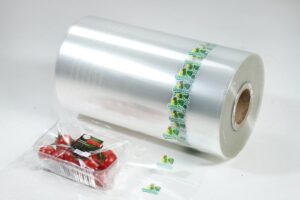
Perforation is a system of small holes in the film that provides:
-
air exchange,
-
removal of excess moisture,
-
reduced condensation.
In practice, different perforation types are used for greens depending on how the product is packed and how intensive the airflow should be. Important: perforation is not “the more holes, the better” — it’s a precise selection of parameters for your specific product.
 Microperforation vs. technical holes
For greens, two approaches are most common:
-
Microperforation — many tiny holes that provide gentle ventilation and help maintain a stable microclimate. Suitable for thin films and packaging where aesthetics and moisture control matter.
-
Technical holes (8 mm) — fewer holes, but stronger airflow. Relevant for greens in bunches, bouquets, and for potted herbs, where respiration and moisture release are higher.
The right number and diameter of holes affect:
-
humidity level inside the pack,
-
speed of wilting,
-
presence or absence of condensation,
-
colour stability and leaf “crispness.”
How perforation helps preserve aroma
Aroma is not just “nice to have.” In retail, it often becomes a freshness marker. Excess moisture without air access creates that “swampy” smell that customers can notice even through packaging — and they won’t buy.
That’s why perforated film allows greens to breathe and preserve their natural aroma. Ventilation removes excess moisture, stabilises the microclimate inside the bag, and helps greens stay fresh longer.
Packaging formats for different types of greens
Cone bags for bunches of herbs and bouquets
Cone bags for greens (a trapezoid/cone shape) are one of the most convenient solutions for bunch herbs, green onions, and “bouquet” formats in retail. They look neat, highlight the product, and perform well in merchandising.
Benefits:
-
“Bouquet” format looks more premium on the shelf.
-
convenient to hold, display, and transport;
-
Ventilation and printing can be added to strengthen branding.
Cone bags with sealed bottoms for potted herbs
If you grow greens in pots, stability and clean transportation are critical. A cone bag with a sealed bottom helps:
-
keep the pot standing securely,
-
prevent leaks and soil spills,
-
maintain a neat look at the point of sale.
These bags are convenient for both retail chains and farm deliveries.
Flat/straight packing bags for chopped greens and salads
For chopped greens, salad mixes, and some microgreens formats, the following work well:
-
straight/flat polypropylene bags for greens (BOPP),
-
roll film for automated lines.
Selection is based on practice: bag width/height, material thickness, perforation zone and intensity depend on product moisture, packing temperature, and logistics.
Packaging for microgreens and salads in trays
The most common format is tray + perforated film (lid/flow-pack). Here, it’s important that the film is transparent with properly selected microperforation, and — if needed — branded printing.
Mini-cases (real-life guidance):
-
If you pack greens in bunches → cone bags + ventilation (microperforation or 8 mm technical holes depending on moisture and logistics).
-
If you pack microgreens in trays → clear film (BOPP/CPP) with microperforation for a stable microclimate.
-
If you grow potted greens → cone bag with sealed bottom + ventilation to avoid the “greenhouse effect” and keep shelf appeal.
Extra options that boost sales and convenience
Additional bag features
With greens, “small details” can give you +1–2 days of freshness and fewer write-offs:
-
technical holes (8 mm) — stronger airflow and less condensation, especially for bunches/pots;
-
Euro slot — useful for premium bouquets displayed on hooks in supermarkets;
-
Reinforcing tape — strengthens the euro-slot area so bags don’t tear during merchandising.
Printing on green packaging
ARTHA-S provides flexographic printing up to 8 colours — a “silent salesperson” on the shelf. You can place on the pack:
-
logo and brand,
-
contact details,
-
product information (variety, country, packing date, storage tips),
-
eco messages (local producer, natural product, etc.).
Branded, custom packaging for greens improves recognition and increases repeat purchases — customers remember not only the greens but your brand.
ARTHA-S capabilities and minimum batches for greens
ARTHA-S is a manufacturer that covers the full packaging cycle for greens:
-
slitting the film to the required width and number of lanes,
-
perforation (hot / euro-perforation, as well as technical holes),
-
custom bag production (cone and flat bags to customer size),
-
flexographic printing up to 8 colours.
Indicative minimum orders:
-
clear film — from 20 kg,
-
clear film with perforation — from 50 kg,
-
cone bags — from 20 kg,
-
bags/film with printing — from 100 kg.
This is convenient for both small farms and large producers supplying retail chains.
Why order greens packaging from ARTHA-S
When you choose packaging, you’re essentially choosing how many days the product will be sold, not written off. ARTHA-S has 20+ years of practical expertise in flexible packaging and a strong specialisation in food solutions, including greens. In-house slitting, perforation, bag making, and printing allow us to develop a solution from scratch for your product and your packing line. Delivery is available across Ukraine.